Values
A capped head half eagle is the old-tenor five-dollar coin of 1813–1834. This page is a series reference, not a price list.
The mintage chart leaves G, VF, and MS-63 blank. The NGC US Coin Price Guide file retrieved 2026-08-21 does not cover this piece. Do not paste an auction hammer into the grade columns.
If you have one and want to sell it, start with how to sell a coin collection. The bust-left half eagle is the previous portrait. The half eagle from 1834 is Classic Head and everything lighter after it.
Key Dates
1813 opens the large cap. 1834 closes the old weight. A Classic Head dated 1834 is not this cap.
Errors
Bust left of 1812. The previous type has a smaller cap and faces left in a different way. Check the head.
Classic Head. The 1834 weight cut is the next page.
Motto or coronet of a Liberty Head. That is later still, and it is also on the 1834–1929 page.
Compare the coin to the NGC Coin Explorer. We do not host their plates.
Varieties
Capped Head, still on the old weight, 1813 through 1834. The diameter comes down late in the run. The Classic Head after the 1834 weight change is the later half eagle page.
- Large diameterThe early capped-head fives, through the large 1829 coins.
- Reduced diameterThe size comes down in 1829 and runs to 1834. It is still a capped head, not the Classic Head.
Names follow PCGS CoinFacts and NGC, the same publishers this site already cites. This is a name list, not a price list and not a count.
Mintage
Capped Head half eagles, 1813–1834, old standard.
| Year | Mint | Mintage | G | VF | MS-63 |
|---|
Mintage: the note under this table names the page that printed each count. These figures are not an NGC Coin Explorer extract and they are not the 1974 Mint pamphlet.
Collector-standard year/mint presentation follows A Guide Book of United States Coins (the Red Book). These cells are Mint manufacture figures, not a Red Book net or melt.
Values: NGC US Coin Price Guide, retrieved 2026-08-21. Guide values, not offers. Not melt. NGC IDs link to the same publisher’s price-guide listing.
Key date names: PCGS CoinFacts (2026-08-21). Bold rows are only dates that publisher named.
The chart is empty on purpose. The half eagle article does not print a year-by-year mintage table. A remembered count does not. The grade columns are empty because this site has no NGC guide extract for this coin.
Specifications
These are mint specs, not what a dealer pays. Wear can take a little weight off. We will not invent a tolerance. The weight row is the 1792 standard for a half eagle. The June 28, 1834 reduction is not this coin. No catalog page used here prints a thickness.
| Specification | Figure |
|---|---|
| Diameter | Not printed |
| Thickness | Not printed |
| Weight | 135 grains standard (Coinage Act of April 2, 1792) |
| Composition | 11/12 gold, 1/12 alloy (Coinage Act of April 2, 1792) |
| Edge | Not printed on a cited catalog page |
| Designer | John Reich |
No catalog page used for the Capped Head half eagle prints a thickness. Diameter and thickness stay Not printed. The weight is the 1792 half-eagle standard. Classic Head is the 1834 reduction.
Grading
A capped head half eagle wears first on the large cap and on the cheek.
This is the old weight. Classic Head, from the 1834 reduction, is the later page.
Key Diagnostic Areas
| Area | What to examine | Why it matters |
|---|---|---|
| Cap | The large cap, head left. | Bust left of 1807–1812 is the previous cap. |
| Date | 1813 through 1834. | A Classic Head date is the reduced coin. |
| Cheek | The cheek. | It is the high point. Leave it alone. |
| Heraldic eagle | The eagle on the reverse. | The reverse is part of the grade. The large cap does not name it. |
| Weight standard | The old tenor, not the 1834 cut. | A light Classic Head is not a worn capped head. |
Circulated & Mint State
These cards describe this coin, not a second copy of the P-1 through MS-70 chart. The shared numbers live on the glossary.
See graded photos. The photos that show what VF looks like live at PCGS. We do not host their plates. NGC Coin Explorer is another look if you want a second set.
What each named grade looks like on this design.
Poor
Poor
A disk you can still call a capped head half eagle if you already know the type.
- The large cap and the cheek are gone.
- The date may be a shadow. Do not scrape it.
- Shine does not make this a better coin.
AG
About Good
You might read a digit. The high points on this capped head half eagle are already slick.
- The large cap and the cheek are worn to a blank patch.
- If you cannot read the date without hoping, stay here.
- A 1813 half eagle is still this grade if it is this worn.
Good
Good
The date is readable. The design is still mostly an outline.
- The large cap and the cheek are flat. The type is an outline, not a portrait.
- The rim should be full enough to hold the legend.
- This is a worn coin, not a details story.
VG
Very Good
The date is clear. A little life returns away from the high points.
- Some leftover detail sits away from the large cap and the cheek.
- The high points are still tired.
- Do not clean the date to “see it better.”
Fine
Fine
You can follow the design. The high points are outlined, not sharp.
- The large cap and the cheek are outlined and flat — no real sharpness yet.
- The rest of the coin can look busier than the grade.
- The date should be clear. The mint mark should be too, if there is one.
VF
Very Fine
The type is doing real work. The large cap and the cheek still decide.
- Leftover detail sits on the large cap and the cheek. The centers are still the worn spot.
- Marks do not raise the grade.
- A regular 1813 half eagle is still this grade if it is this worn.
EF
Extremely Fine
Most of the coin looks sharp. The high points tell on it.
- Light wear on the large cap and the cheek.
- The rest of the coin can look better than the grade. Trust the high points.
- The date should be sharp.
AU
About Uncirculated
Almost no wear — and “almost” lives on the same high points.
- A trace of rub on the large cap and the cheek.
- Luster may still sit in the fields. Rub on those high points is still rub.
- A bright coin with a slick high point is still slick.
Basal MS
Mint State
No wear. The fight is marks and luster, not how white the coin looks.
- No rub on the large cap and the cheek.
- Marks and luster decide how this mint-state coin lives.
- A bright chewed-up coin is still chewed-up.
Choice
Choice Mint State
Still no wear. Cleaner fields than basal mint state.
- Same no-wear rule on the large cap and the cheek.
- Fewer marks in the fields. Luster is more intact.
- White is not a grade.
Gem
Gem Mint State
A clean capped head half eagle for this type. Still mint state, still not a story.
- No wear on the large cap and the cheek.
- Marks and luster, not a romance about a date or a white field.
- A slab is an opinion in plastic. The glossary has the numbers.
This page does not invent a PR price grid. The proof numbers live on the glossary.
Copper color designations do not apply to this gold coin. See the Lincoln Wheat cent and the glossary.
Overview
The capped head half eagle runs from 1813 to 1834 on the original half-eagle weight. The portrait is the large cap, still facing left, before the Mint cut the gold content. Classic Head, Liberty Head, and Indian Head half eagles share the later page because they share the reduced standard and the dates after this type.
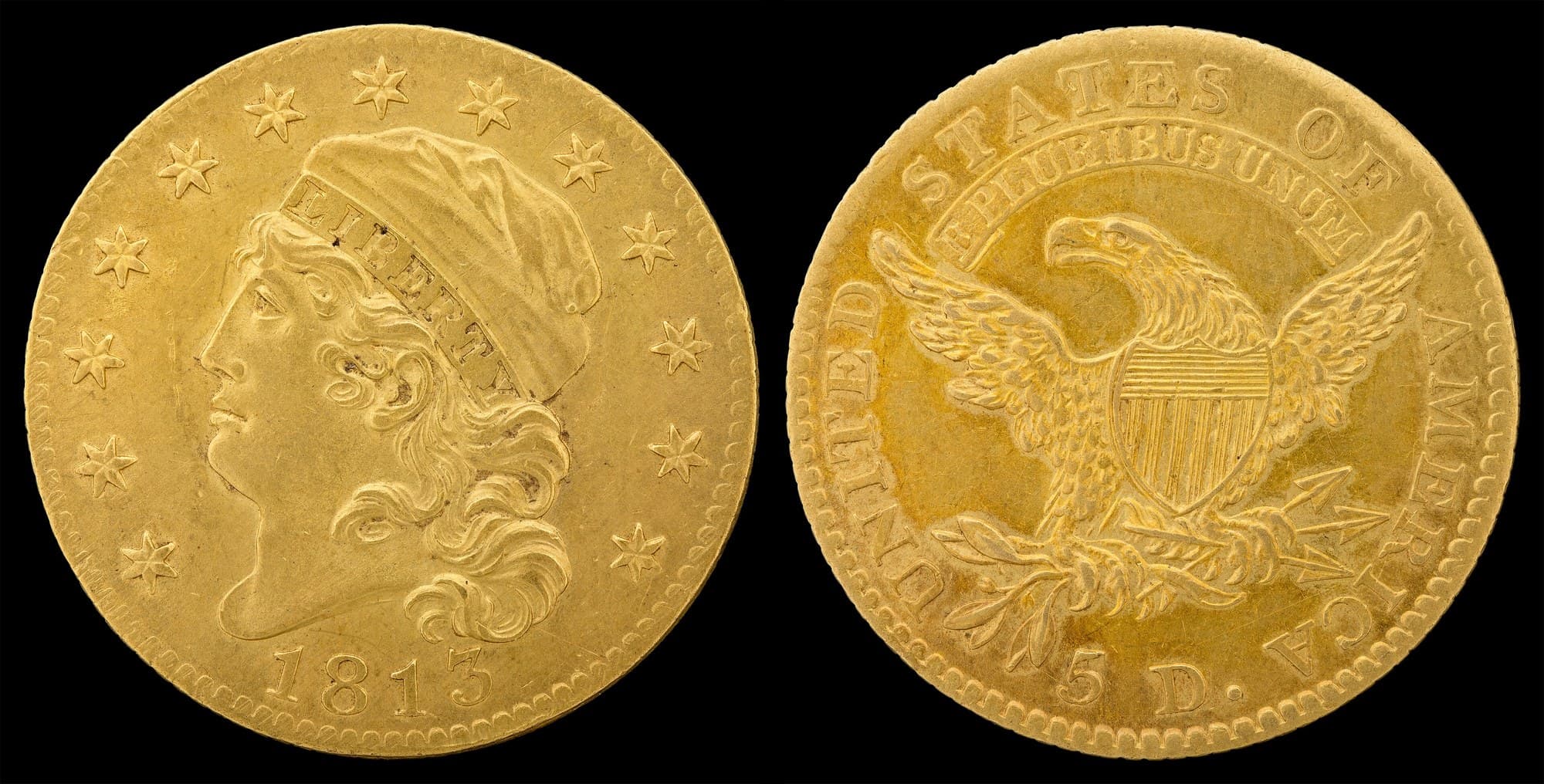
The photograph is an 1813 Capped Head half eagle from the National Numismatic Collection.
This page is a series article, not a shop listing.
History
Reich’s capped head replaced the bust-left half eagle in 1813. It stayed in production until the 1834 law made the old coins worth more as gold than as money. The article does not print the year ledger. This page stops at that fact.
Design
Obverse: large cap, head left. Reverse: heraldic eagle. Five dollars. No mint mark on this type as published here. The cap is larger than the 1807–1812 bust.
People Also Ask
Why is the chart empty?
The half eagle article does not print year counts for 1813–1834. This page will not invent the old-tenor deliveries.
Does 1834 include the Classic Head?
Classic Head is the reduced-weight coin on the half eagle page that starts in 1834. This page is the capped head that ends when that weight changes.
Were these struck only in Philadelphia?
The early capped head is a Philadelphia type. This page does not add branch-mint rows the source does not print.
How much is a capped head half eagle worth?
This page does not print guide prices. The NGC US Coin Price Guide file retrieved 2026-08-21 does not include this coin. An auction result is not a guide cell.
Collector Considerations
A capped head and a Classic Head can both read 1834. The head tells you which page. Do not average their weights.
A Final Word
The capped head half eagle page is the old weight through 1834, and an empty chart.
An auction story is not a mintage.