Values
A Morgan dollar’s market depends on the date, the mint mark, the grade, and whether someone has already cleaned it. This page is a series reference, not a price list.
The G, VF, and MS-63 columns sit in the mintage chart below. Those figures are from the NGC US Coin Price Guide, retrieved 2026-08-21. They are a published guide, not an offer and not melt. A blank cell means that grade was not printed in this pass. 1895 Philadelphia is proof only on the NGC sheet. PF-60 and PF-63 sit on that row. Other years are business strikes, so those proof columns stay off the chart.
A dealer looking at the coin in hand will beat a guide number. If you are trying to sell a pile of them, start with how to sell a coin collection and the Ohio coin dealer directory.
Key Dates
These are the dates collectors ask about first. This is a name list, not a price list and not a mintage table. Carson City is not automatically a key. A worn common date is still worn.
- 1889-CC
- 1893-S
- 1893-CC
- 1894
- 1895
- 1895-O
- 1895-S
Key date names: PCGS CoinFacts. This is a name list, not a price list.
Key dates are bolded on the mintage chart. Semi-key dates are marked more quietly.
1878 eight-tail-feather versus seven-tail-feather is a variety conversation. It is not the same thing as a key date.
Errors
Named pieces only. This is not a VAM dump, and it is not a price list.
1878 is a design fight, not a mint error. The first reverse had eight tail feathers. The Mint then changed to seven, and there is a 7-over-8 transition. Collectors talk about 8 TF, 7 TF, and 7/8 TF. Those are varieties. They are not a coin that left the press wrong.
1888-O has a doubled die obverse that PCGS and NGC both call “Hot Lips.” The doubling sits on Liberty’s lips. Look it up on PCGS CoinFacts or compare a normal Morgan on PCGS Photograde. This page will not invent a bid for one.
A wiped cheek, a hole, or a scratch is damage. It is not an error, no matter what the listing title says.
Varieties
These are the design subtypes and the VAM highlights standard guides treat as major on Morgan dollars. A VAM is a die marriage, not a grade. This is not every VAM.
- 1878 8 tail feathersThe first reverse has eight tail feathers. Later 1878 reverses have seven. PCGS and NGC both list the eight-feather reverse.
- 1878 7 tail feathersThe seven-feather reverse is the one most later Morgans use. It is a design change in 1878, not a mint error.
- 1878 7/8 tail feathersA transition reverse: seven feathers punched over eight. Guides list it beside the eight-feather and seven-feather coins.
- 1878 reverse of 1879Some 1878 coins use the reverse that becomes standard in 1879, with a different eagle feather. Guides separate it from the reverse of 1878.
- 1879-S reverse of 1878Some 1879-S dollars keep the earlier reverse. NGC and PCGS both name that reverse.
- 1880/79-CCCarson City overdates. Guides list more than one 1880/79-CC punch. This page does not split a count.
- 1880-CC 8/7Guides list an 8 over a high 7 and an 8 over a low 7. Both are date punches, not a second mint.
- 1887/6 and 1887/6-OOverdates at Philadelphia and New Orleans. PCGS and NGC both name them.
- 1888-O Hot LipsA doubled die obverse. The doubling sits on Liberty’s lips. PCGS CoinFacts calls it VAM-4, the same name this page already uses.
- 1900-O/CCAn O mint mark punched over CC. Guides list it as its own variety under the New Orleans date.
- 1901 doubled die reverseA doubled reverse that PCGS and NGC both name. It is a die variety, not a second mintage row.
Names follow PCGS CoinFacts and NGC, the same publishers this site already cites. This is a name list, not a price list and not a count.
Mintage
Mints in the original series are Philadelphia (no mint mark), New Orleans (O), San Francisco (S), and Carson City (CC). Denver (D) appears on the 1921 coins.
| Year | Mint | Mintage | NGC ID | G | VF | MS-63 |
|---|---|---|---|---|---|---|
| 1878 | P | 10,509,550 NGC printed 7TF Reverse of 1878. | — | $50 | $60 | $175 |
| 1878 | S | 9,774,000 | 17082 | $62 | $66 | $140 |
| 1878 | CC | 2,212,000 | 17080 | $160 | $225 | $700 |
| 1879 | P | 14,807,100 | 17084 | $62 | $66 | $135 |
| 1879 | S | 9,110,000 | 17092 | $62 | $66 | $130 |
| 1879 | O | 2,887,000 | 17090 | $62 | $66 | $490 |
| 1879 | CC | 756,000 Semi-key | 17086 | $215 | $1,175 | $10,000 |
| 1880 | P | 12,601,355 | 17096 | $62 | $66 | $130 |
| 1880 | S | 8,900,000 | 17118 | $62 | $66 | $130 |
| 1880 | O | 5,305,000 | 17114 | $62 | $66 | $650 |
| 1880 | CC | 591,000 | 17100 | $250 | $400 | $850 |
| 1881 | P | 9,163,975 | 17124 | $62 | $66 | $130 |
| 1881 | S | 12,760,000 | 17130 | $62 | $66 | $130 |
| 1881 | O | 5,708,000 | 17128 | $62 | $66 | $130 |
| 1881 | CC | 296,000 | 17126 | $320 | $435 | $725 |
| 1882 | P | 11,101,100 | 17132 | $62 | $66 | $130 |
| 1882 | S | 9,250,000 | 17140 | $62 | $66 | $130 |
| 1882 | O | 6,090,000 | 17136 | $62 | $66 | $130 |
| 1882 | CC | 1,133,000 | 17134 | $115 | $165 | $390 |
| 1883 | P | 12,291,039 | 17142 | $62 | $66 | $130 |
| 1883 | S | 6,250,000 | 17148 | $62 | $66 | $3,150 |
| 1883 | O | 8,725,000 | 17146 | $62 | $66 | $130 |
| 1883 | CC | 1,204,000 | 17144 | $135 | $200 | $390 |
| 1884 | P | 14,070,875 | 17150 | $62 | $66 | $130 |
| 1884 | S | 3,200,000 Semi-key | 17156 | $62 | $85 | $50,000 |
| 1884 | O | 9,730,000 | 17154 | $62 | $66 | $130 |
| 1884 | CC | 1,136,000 | 17152 | $135 | $200 | $390 |
| 1885 | P | 17,787,767 | 17158 | $62 | $66 | $130 |
| 1885 | S | 1,497,000 | 17164 | $62 | $66 | $575 |
| 1885 | O | 9,185,000 | 17162 | $62 | $66 | $130 |
| 1885 | CC | 228,000 | 17160 | $550 | $615 | $875 |
| 1886 | P | 19,963,886 | — | $50 | $60 | $110 |
| 1886 | S | 750,000 | — | $70 | $110 | $575 |
| 1886 | O | 10,710,000 | — | $50 | $70 | $2,100 |
| 1887 | P | 20,290,710 | — | $50 | $60 | $110 |
| 1887 | S | 1,771,000 | — | $50 | $65 | $325 |
| 1887 | O | 11,550,000 | — | $50 | $60 | $225 |
| 1888 | P | 19,183,833 | — | $50 | $60 | $110 |
| 1888 | S | 657,000 | — | $70 | $135 | $475 |
| 1888 | O | 12,150,000 | — | $50 | $60 | $150 |
| 1889 | P | 21,726,811 | — | $50 | $60 | $110 |
| 1889 | S | 700,000 | — | $55 | $75 | $425 |
| 1889 | O | 11,875,000 | — | $50 | $60 | $325 |
| 1889 | CC | 350,000 | — | $1,350 | $3,250 | $85,000 |
| 1890 | P | 16,802,590 | — | $50 | $60 | $110 |
| 1890 | S | 8,230,373 | — | $50 | $60 | $150 |
| 1890 | O | 10,701,000 | — | $50 | $60 | $275 |
| 1890 | CC | 2,309,041 | 17198 | $110 | $165 | $1,000 |
| 1891 | P | 8,694,206 | 17204 | $62 | $66 | $170 |
| 1891 | S | 5,296,000 | 17210 | $62 | $66 | $185 |
| 1891 | O | 7,954,529 | 17208 | $62 | $66 | $445 |
| 1891 | CC | 1,618,000 | 17206 | $95 | $165 | $800 |
| 1892 | P | 1,037,245 | 17212 | $62 | $66 | $525 |
| 1892 | S | 1,200,000 Semi-key | 17218 | $62 | $185 | $85,000 |
| 1892 | O | 2,744,000 | 17216 | $62 | $66 | $525 |
| 1892 | CC | 1,352,000 | 17214 | $250 | $650 | $3,150 |
| 1893 | P | 378,792 | 17220 | $300 | $550 | $3,000 |
| 1893 | S | 100,000 | 17226 | $4,000 | $8,500 | $335,000 |
| 1893 | O | 300,000 Semi-key | 17224 | $250 | $600 | $12,000 |
| 1893 | CC | 677,000 Semi-key | 17222 | $220 | $1,000 | $7,000 |
| 1894 | P | 110,972 | 17228 | $725 | $975 | $5,000 |
| 1894 | S | 1,260,000 | 17232 | $62 | $115 | $1,400 |
| 1894 | O | 1,723,000 | 17230 | $62 | $90 | $5,000 |
| 1895 | P | 12,880 Pamphlet prints 12,880 dollars; PCGS/NGC treat 1895 as Proof only. NGC printed PF-60 $32,500 and PF-63 $45,000. | 17330 | — | — | — |
| 1895 | S | 400,000 Semi-key | 17238 | $300 | $995 | $7,350 |
| 1895 | O | 450,000 Semi-key | 17236 | $230 | $385 | $65,000 |
| 1896 | P | 9,976,762 | 17240 | $62 | $66 | $130 |
| 1896 | S | 5,000,000 | 17244 | $62 | $185 | $4,250 |
| 1896 | O | 4,900,000 | 17242 | $62 | $80 | $6,250 |
| 1897 | P | 2,822,731 | 17246 | $62 | $66 | $130 |
| 1897 | S | 5,825,000 | 17250 | $62 | $66 | $150 |
| 1897 | O | 4,004,000 | 17248 | $62 | $66 | $4,350 |
| 1898 | P | 5,884,735 | 17252 | $62 | $66 | $130 |
| 1898 | S | 4,102,000 | 17256 | $62 | $66 | $935 |
| 1898 | O | 4,440,000 | 17254 | $62 | $66 | $130 |
| 1899 | P | 330,846 | 17258 | $125 | $160 | $400 |
| 1899 | S | 2,562,000 | 17262 | $62 | $85 | $725 |
| 1899 | O | 12,290,000 | 17260 | $62 | $66 | $130 |
| 1900 | P | 8,880,938 | 17264 | $62 | $66 | $130 |
| 1900 | S | 3,540,000 | 17270 | $62 | $66 | $525 |
| 1900 | O | 12,590,000 | 17266 | $62 | $66 | $130 |
| 1901 | P | 6,962,813 | 17272 | $62 | $100 | $12,000 |
| 1901 | S | 2,284,000 | 17276 | $62 | $66 | $950 |
| 1901 | O | 13,320,000 | 17274 | $62 | $66 | $130 |
| 1902 | P | 7,994,777 | 17278 | $62 | $66 | $260 |
| 1902 | S | 1,530,000 | 17282 | $95 | $150 | $760 |
| 1902 | O | 8,636,000 | 17280 | $62 | $66 | $130 |
| 1903 | P | 4,652,755 | 17284 | $62 | $66 | $135 |
| 1903 | S | 1,241,000 Semi-key | 17288 | $85 | $190 | $7,750 |
| 1903 | O | 4,450,000 | 17286 | $260 | $425 | $515 |
| 1904 | P | 2,788,650 | 17290 | $62 | $66 | $315 |
| 1904 | S | 2,304,000 | 17294 | $62 | $110 | $5,000 |
| 1904 | O | 3,720,000 | 17292 | $62 | $66 | $130 |
| 1921 | P | 45,696,473 Pamphlet does not split Morgan vs Peace. | 17296 | $59 | $63 | $120 |
| 1921 | D | 20,345,000 Pamphlet does not split Morgan vs Peace. | 17298 | $59 | $63 | $170 |
| 1921 | S | 21,695,000 Pamphlet does not split Morgan vs Peace. | 17300 | $59 | $63 | $175 |
Mintage: United States, Bureau of the Mint, Domestic and Foreign Coins Manufactured by Mints of the United States, 1792-1965 (Washington, D.C.: GPO, 1974). Publisher: FRASER / GPO pamphlet.
Collector-standard year/mint presentation follows A Guide Book of United States Coins (the Red Book). These cells are Mint manufacture figures, not a Red Book net or melt.
Values: NGC US Coin Price Guide, retrieved 2026-08-21. Guide values, not offers. Not melt. NGC IDs link to the same publisher’s price-guide listing.
Key date names: PCGS CoinFacts (2026-08-21). Bold rows are only dates that publisher named.
NGC ID: NGC Coin Explorer listing number, retrieved 2026-08-21. A dash means this pass did not record an ID.
No 1886–1888 CC dollar rows (blank in the pamphlet).
PF-60 and PF-63 print only on 1895-P. Other Morgan rows are business strikes. Those proof columns stay off the chart so empty proof cells do not look like missing prices.
These are Bureau of the Mint manufacture figures from the 1974 GPO pamphlet in this repository, not a Red Book net or melt. The grade columns in the same box are NGC guide values from 2026-08-21, not an offer. The NGC ID column is the Coin Explorer listing for that date when this pass recorded one. A dash means this pass did not record an ID. Philadelphia coins have no mint mark. The pamphlet leaves 1886–1888 Carson City dollar cells blank, so those rows are omitted. A 1921 dollar count is not split between Morgan and Peace. PCGS and NGC treat circulation 1895 as Proof only; the Philadelphia line is the pamphlet print figure, and the NGC sheet prints PF-60 and PF-63 instead of G / VF / MS-63.
Read the date, read the mint mark, and compare the coin in your hand to another coin of the same date. “CC means rare” is a slogan. Some CC dates are chased; some are just expensive relative to a common Philadelphia coin in the same grade.
Specifications
These are mint specs — the diameter, the weight, the alloy. They are not what a dealer pays. A coin that lived in a pocket can lose a little weight. We will not invent a tolerance for that.
| Specification | Figure |
|---|---|
| Diameter | 38.1 mm (1.5 in) |
| Thickness | 2.40 mm |
| Weight | 26.73 g (412.5 grains) |
| Composition | 90% silver, 10% copper |
| Fine silver | 0.77344 troy oz. Melt math uses this figure. It does not appraise a coin. |
| Edge | Reeded |
| Designer | George T. Morgan |
Coinage Act standard for the silver dollar (412.5 grains, .900 fine) as used by the U.S. Mint for this series. Stack’s Bowers Coin Resource Center lists the same 26.73 g / 38.1 mm / 90% silver. Thickness 2.40 mm is the Numista type page (N#1492, KM# 110).
Grading
A Morgan wears first in the hair over Liberty’s ear, the lines in the cap, and the eagle’s breast. Those three spots go flat before the rest of the coin looks tired.
Bag marks — the little hits from other dollars in a bag — show up on the cheek and the fields. A bright coin with a chewed-up cheek is still a chewed-up cheek. Eight tail feathers versus seven is a variety, not a grade.
Key Diagnostic Areas
| Area | What to examine | Why it matters |
|---|---|---|
| Hair over Liberty’s ear | The locks just above the ear, where the hair is highest. | This is the first hair to go flat. Wear here moves a circulated grade more than a pretty tone. |
| Lines in the cap | The cap above the forehead and the lines that run through it. | Those lines flatten with the hair. If they are gone, the coin has been in a pocket. |
| Eagle’s breast | The feathers on the center of the eagle’s chest. | The breast goes slick while the wings still look busy. Read the breast, not the story. |
| Cheek and fields | Bag marks on Liberty’s cheek and in the open fields. | On mint-state coins, marks and luster decide the number. White is not a grade. |
Circulated & Mint State
These cards describe this coin, not a second copy of the P-1 through MS-70 chart. The shared numbers live on the glossary.
See graded photos. The photos that show what VF looks like live at PCGS. We do not host their plates. Compare the coin in hand to PCGS Photograde. NGC Coin Explorer is another look if you want a second set.
What each named grade looks like on this design.
Poor
Poor
A silver disk you can still call a Morgan if you already know the design.
- Hair over Liberty’s ear is gone. The cap is a blank.
- The eagle’s breast is a smooth lump. Feathers are not a conversation.
- The date may be hard. Shine does not make this a better coin.
AG
About Good
You can read the date. The high points are already slick.
- Hair over the ear is worn to a blank patch.
- Lines in the cap are gone. The eagle’s breast is flat.
- Liberty is still a head, not a portrait.
Good
Good
The rim is full enough to read. The design is an outline.
- Hair over the ear is gone. Cap lines are gone.
- The eagle’s breast is smooth while the wings can still look busy.
- This is a worn dollar, not a “details” story.
VG
Very Good
Some hair is left away from the ear. The ear itself is still flat.
- Read the hair over the ear first. If that patch is slick, stay here.
- The cap is still tired. A few outer lines may hint at themselves.
- The eagle’s breast is worn. Leftover wing feathers do not save it.
Fine
Fine
You can follow Liberty’s head, but the high points are outlined, not sharp.
- Hair over the ear is outlined and flat — no real strands yet.
- A few lines return in the cap.
- The eagle’s breast starts to show leftover feather, not a full coat.
VF
Very Fine
The design is there. The three high points are still the argument.
- Leftover lines sit in the hair over the ear and in the cap.
- The eagle’s breast has leftover feathers. The center is still the worn spot.
- Bag marks on the cheek can already be ugly. They do not raise the grade.
EF
Extremely Fine
Most of the coin looks sharp. The high points tell on it.
- Light wear on the hair over the ear, the cap lines, and the eagle’s breast.
- Those three spots go first. A pretty tone does not hide a flat breast.
- The rest of the coin can look better than the grade. Trust the high points.
AU
About Uncirculated
Almost no wear — and “almost” lives on the same three spots.
- A trace of rub on the hair over the ear, the cap, and the eagle’s breast.
- Luster may still sit in the fields. Rub on those high points is still rub.
- Bag marks on the cheek already count. A bright chewed cheek is still chewed.
Basal MS
Mint State
No wear. The fight is marks and luster, not how white the cheek looks.
- Hair over the ear, cap lines, and the eagle’s breast show no rub.
- Bag marks on the cheek and fields decide how this mint-state coin lives.
- A bright coin with a chewed-up cheek is still a chewed-up cheek.
Choice
Choice Mint State
Still no wear. The cheek and fields are cleaner than basal mint state.
- Same no-wear rule on the ear, the cap, and the breast.
- Fewer bag marks on the cheek and in the fields. Luster is more intact.
- White is not a grade. Eight tail feathers versus seven is still a variety.
Gem
Gem Mint State
A clean cheek and fields for a Morgan. Still mint state, still not a story.
- No wear on the hair over the ear or the eagle’s breast.
- Marks and luster, not a romance about Carson City or a white cheek.
- A slab is an opinion in plastic. The coin in the holder is the coin.
Proof
Proofs were made as proofs. The PR-60 through PR-70 numbers live on the glossary.
Proof look on this series. Not a second PR number chart.
Proof
Proof
Made as a proof for part of the run — not a circulation strike someone shined later.
- Hairlines in the fields matter more than a white cheek.
- The same high points exist. Wear would mean you are not looking at a proof in the usual sense.
- PR numbers live on the glossary. This card is the look, not the chart.
Choice
Choice Proof
Same proof surfaces, fewer hairlines.
- Still a coin that was made as a proof.
- Cameo contrast is a separate call. Look at the glossary for CAM and DCAM.
- Do not promote a business strike because the cheek is white.
Gem
Gem Proof
Clean mirrors on a coin that left the Mint as a proof.
- Deep Cameo is frost on the devices against those mirrors.
- A white business-strike cheek is not Deep Cameo.
- The PR-60 through PR-70 numbers stay on the glossary.
Cameo designations
Cameo contrast is a proof conversation. A business-strike Morgan does not become a Deep Cameo because the cheek is white. The name list also lives on the glossary.
| Designation | Abbreviation | Description | Premium |
|---|---|---|---|
| No designation | — | A proof without a cameo contrast call on the label. Still a proof. Still not a circulation strike. | base |
| Cameo | CAM | Frosted devices against mirrored fields, with enough contrast to be called on a proof. | moderate |
| Deep Cameo | DCAM | Strong, even frost against deep mirrors on a proof. A white business-strike cheek is not this. | significant |
Copper color designations (BN, RB, RD) do not apply here. Those belong on copper coins such as the Lincoln Wheat cent. See the Lincoln Wheat cent and the glossary.
Overview
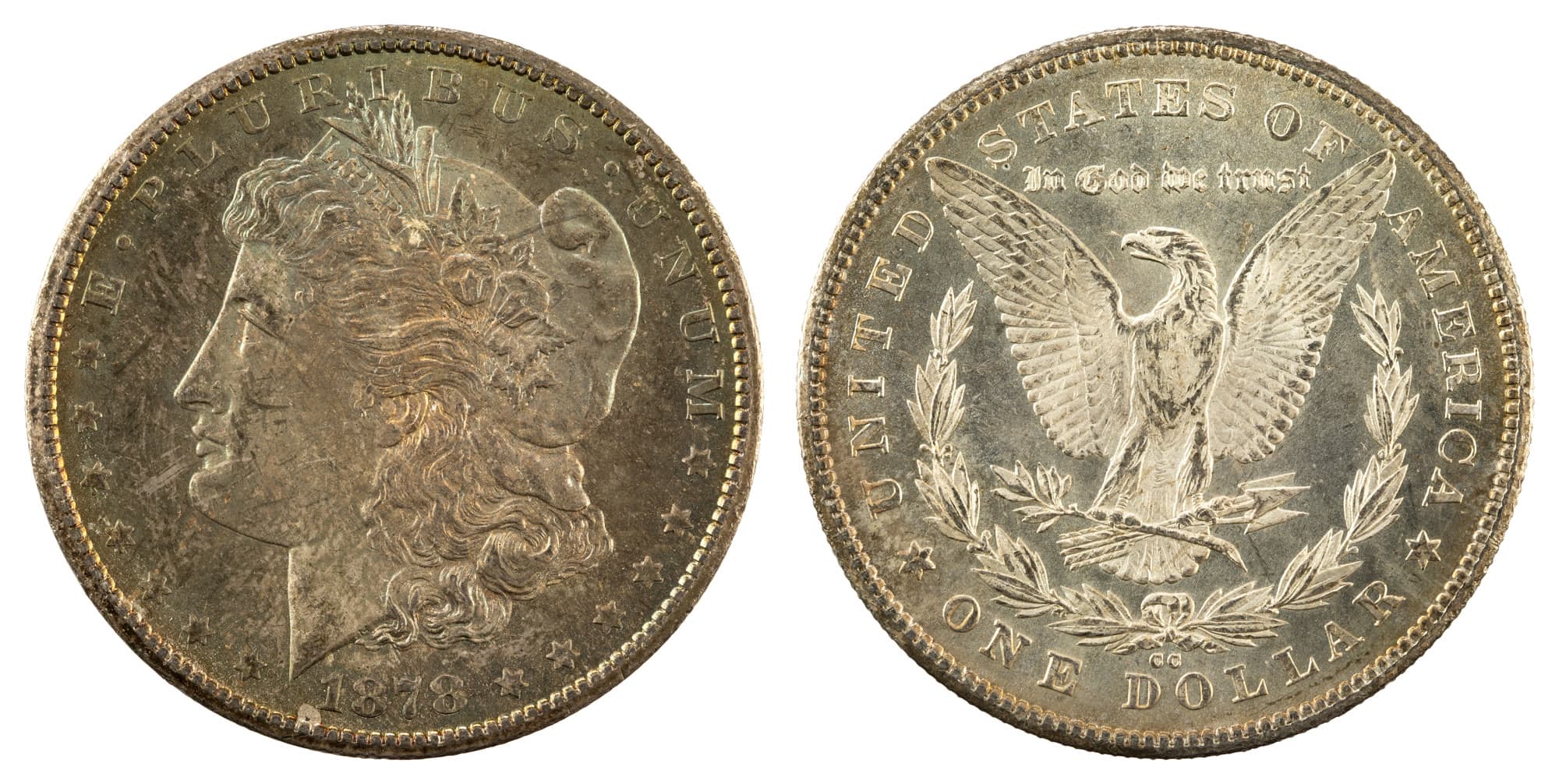
A Morgan dollar is a United States silver dollar with a large Liberty head on the front and an eagle on the back. Collectors mean the coins struck from 1878 through 1904, then the one-year return in 1921.
People like them because they are big enough to hold like a real object, the design still reads across a table, and the date-and-mint combinations give you something to chase without needing a lecture. They are also easy to ruin. A wiped coin looks “better” to a seller and worse to everyone else.
This page is a series article, not a shop listing.
History
The series starts in 1878 with George T. Morgan’s design, made under the Bland-Allison Act. The Mint needed a silver dollar again, and Morgan — an English engraver working in the United States — produced the head of Liberty that the coins are named for. The usual story is that Anna Willess Williams sat for the portrait. Treat that as the story people tell, not as something this page can prove from a document in this repo.
Most of the run is 1878–1904. Then the presses stop. The Pittman Act of 1918 later sent a huge number of older silver dollars into the melting pot. That is why so many dates feel common in conversation and scarce in a drawer: melting is not the same thing as a printed mintage, and this page will not invent the melt totals either.
In 1921 the Mint struck Morgan dollars again, then shifted to the Peace dollar the same year. A 1921 Morgan is part of the series. It is not a restrike of 1878, 1893, or any other earlier date. The modern 2021 Morgan products from the Mint are commemorative pieces. They are not original 1878–1921 coins and they are not restrikes of those coins. Later collector issues use a different fineness. The article’s rows after 1921 mix a privy-mark split, proof finishes, and unfinished years, so they are not added to this circulation chart.
Carson City coins carry a romance that the other mints do not. Romance is not a grade. A worn CC coin is still worn.
Design
Obverse: Liberty facing left, a cap, agricultural details in the hair, thirteen stars, the date below. Reverse: an eagle with wings raised, a wreath, “In God We Trust,” and the mint mark below the wreath when the coin is not from Philadelphia.
1878 has a design fight people still argue about at a counter: eight tail feathers versus seven. That is a variety conversation, not a mintage conversation. Later years settle into the seven-tail-feather reverse most people picture when they say “a Morgan.”
Look at the hair over Liberty’s ear, the lines in the cap, and the eagle’s breast. Those spots go flat first. Bag marks — the little hits from other dollars in a bag — show up on the cheek and the fields. A bright coin with a chewed-up cheek is still a bright coin with a chewed-up cheek.
Proof Morgans exist for part of the run. They were made as proofs, not as circulation strikes that someone shined later.
People Also Ask
How much is a Morgan dollar worth?
It depends on the date, the mint mark, and the grade. This page is a series reference, not a price list, and a dealer looking at the actual coin will beat any number typed from memory.
Which years were Morgan dollars made?
Circulation Morgan dollars were struck from 1878 through 1904, then again in 1921. There is no 1905–1920 Morgan in the original series.
Why is there a gap after 1904?
The Mint stopped the series after 1904. Silver-dollar production came back in 1921, first as Morgans and then as the new Peace dollar. The 1921 Morgan is a later original striking, not a restrike of an earlier date.
Are Morgan dollars 90 percent silver?
The original circulation coins are 90 percent silver and 10 percent copper. That is composition, not a value quote. Wear, cleaning, and holes still matter more than the alloy line in a book.
Should I clean a Morgan dollar before I sell it?
No. Dip, polish, or a kitchen scrub usually cuts the price. Leave the coin as it is and let a dealer tell you what they see.
Collector Considerations
Buy the coin, not the story. A common date in a high grade can cost more than a better date that is chewed up. That is normal.
If you inherited a box, do not sort them with a kitchen towel and a video. Keep them in the holders they arrived in, or in cheap cardboard flips, and take the box to a person who sees Morgans every week. The coin dealer directory starts in Ohio. This site does not invent shop names to fill a paragraph.
Raw coins are fine. So are slabs. What is not fine is a coin that has been dipped until the luster looks like glass, then offered as “blast white.” Say what happened if you know. A dealer will see it anyway.
If you collect by type, one honest 1921 and one earlier date will teach you more than a spreadsheet. If you collect by mint mark, give yourself time. Carson City is a rabbit hole with a cover charge.
A Final Word
Morgan dollars reward people who slow down. Read the date. Read the mint mark. Leave the silver polish under the sink.
When you want the next series on this site, use the Buffalo nickel or the Lincoln Wheat cent.